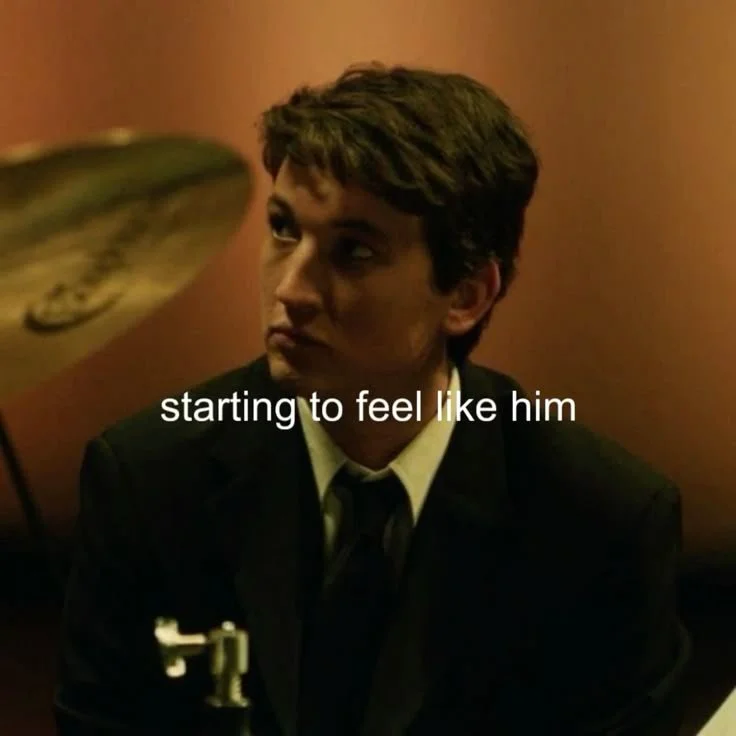
Film notes: Whiplash
April 15, 2026
I come with no intention of playing the film critic. "Film notes" is intended to be a series of unpretentious thoughts on the films I watch and want to recommend. You will get to meet a version of me who is incredibly annoying about her cinematic finds and will make you watch an entire trailer for every recommendation she gives you. I'd like these journal entries to be written right after a screening, so I can capture feelings still in digestion about what I’ve just seen. That’s why I’m writing this to you from the sofa in my living room, with the credits still rolling.
Damien Chazelle, the genius you are! I’ve been sleeping on this one, but I might have picked the best time to watch it. A time where I understand Andrew’s devotion to his craft, as well as the accumulating pressure that comes with it. Needless to say, his struggles put mine into a whole new perspective — I’m neither aspiring to be the best in the world, nor being abused by a sociopathic teacher (props to J. K. Simmons for a fantastic performance). To me, the film is a hyperbolic representation of certain internal struggles common to the human experience. I assume we can all relate to one aspect or another of it, especially if we are career-driven, and even more so if that career is in the arts.
The scene where Andrew's hands are bleeding while he practises really struck me. For some context, I can’t stand blood. Even common expressions that mention it — like "blood, sweat and tears" or "bleeding for" or "into" something — feel too visceral to me. In that scene, I could almost feel his pain, yet I couldn't look away. I still haven’t decided how I feel about the idea that great suffering produces great art. Does it? To some extent, suffering is inherent in my academic practice in design and also in my work in ceramics. No bullying teacher is required, though, because I am my own harshest critic.
It’s not unusual for it to take burnout or hitting rock bottom to force us to slow down. That’s what has been keeping a workaholic like me sane. Acknowledging that I hold the power to make the rush stop abruptly when it’s too much is a freeing sensation. Not in the sense that I don’t give a fuck about the work I’m doing, because I care a lot, but because work isn’t everything. I believe a life that doesn’t revolve entirely around work benefits the work itself. It creates a desired balance. But going back to the film, perhaps a holistic, pleasurable and healthy relationship with one’s craft doesn’t help us become the best, but instead moves us away from that pedestal. For now, I think I choose balance.
Despite my personal take on (not) becoming the greatest in my endeavours, there is breathtaking art that comes out of isolating, manic, suffering-driven pursuits. So I love that Whiplash doesn’t help me settle on an opinion, but continues to make me question ambition, method, and whether the means justify the ends.